










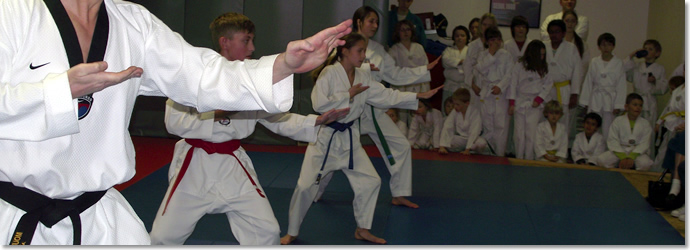
Overview of Taekwondo
Taekwondo is an exciting martial art that combines a variety of kicks, strikes, and blocks into a dynamic system of sport, self-defense, and fun. Although taekwondo is familiar as an Olympic-sport, its origins are as an effective method for self-defense with powerful striking and kicking combinations. More importantly, taekwondo is an activity that reinforces positive characteristics to assist individuals to become better citizens of the community. Through regular training, participants develop and learn the value of self-confidence, self-respect, and self-restraint.
What are the Benefits? (Return to Top)
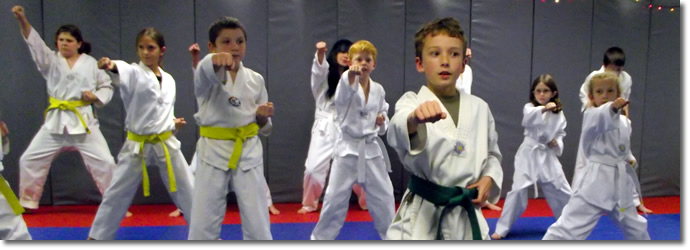
With regular training, participants improve their balance, flexibility, strength, coordination, and aerobic fitness. A typical training session includes warm-up exercises, stretching, strength exercises, and kicking and punching drills either individually or with partners. Form, or poomsae (pronounced "poom say"; prearranged movements) training is practiced on a regular basis to improve technique, balance/posture, timing, and focus.
Go to: Taekwondo Techniques
Learn more about the types of techniques and movements in taekwondo.
Technical System (Return to Top)
The technical system of taekwondo includes the following five elements: Basic Movements (kibondongjak), Forms (poomsae), Sparring (kyorugi), Breaking (kyukpa), and Self-Defense(hoshinsul).

1. BASIC MOVEMENTS. Basic movements are movements that become fundamentals. Fundamentals that are precise and powerful become effective techniques for defense and health. Basic movements include the following.
Blocking & Striking: Proper movement is important to effectively block and strike. Precise movements develop into effective techniques.
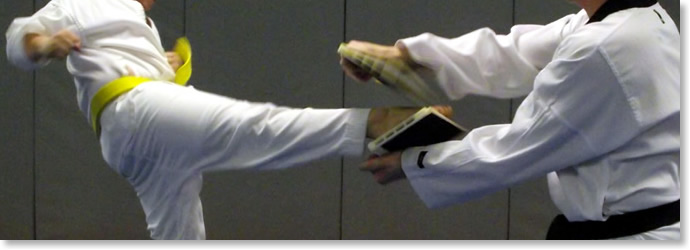
Kicking: It is especially important that kicking training emphasize precise movements. For example, the effect of pivoting of the trunk when kicking affects balance and therefore requires close attention to how the leg moves.
Footwork: An easily overlooked yet critical component of taekwondo is effective footwork that enables a person to move from Point A to Point B efficiently. It's not enough to simply go forward into trouble; it's equally important to be able to back away from trouble and even move away at odd, unexpected angles. And moving well requires good balance at all times. It does no good to stumble or fall down while moving to for attack or defense.
2. FORMS. Forms, or poomsae (pronounced, “poom-say”), training is performing pre-arranged striking and kicking techniques in a pattern for attack and defense. Forms practice, either alone or in a group, is excellent for low impact exercise for improving balance and coordination. Performed properly, poomsae reflects the elegant application of power that the human body is capable.
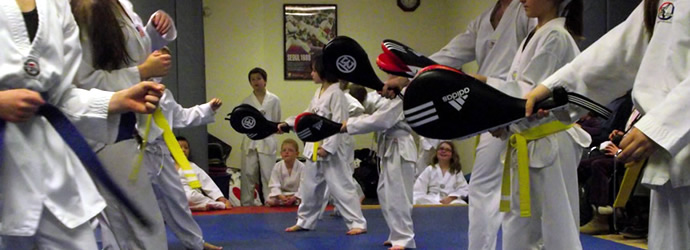
3. SPARRING. There are two types of sparring in taekwondo: arranged and free. Each type involves using various skills against an attacker/opponent in a controlled situation. Safety is always a priority for MSMAP in any type of drill or exercise.
Arranged Sparring: In brief, one person attacks and one person defends using a variety of options (blocks, strikes, kicks). The defender can use whichever techniques they are familiar and have practiced. The attakcs and defenses are arranged in advance in order to develop a better understanding of distance, balance, targeting, and effectiveness of technique. Arranged sparring is often emphasized prior to beginning any free sparring practice.
Free Sparring: This is a very sophisticated system of one-on-one combat. Participants are allowed, within the rules for safety, to apply a wide variety of kicking techniques and combinations against each other. A significant challenge is that the target is moving so distance continually changes and there is no knowing in advance of what will happen. For full-contact free sparring, participants wear protective equipment. Free sparring integrates power, speed, coordination, reaction, and deceptively graceful movement.
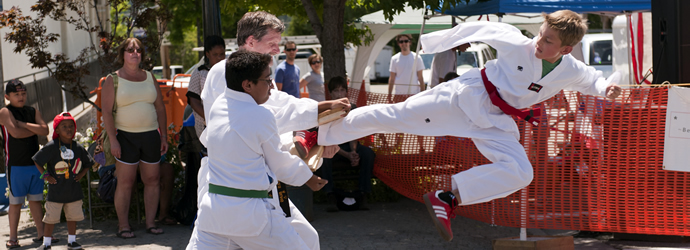
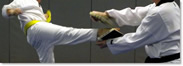
4. BREAKING. Breaking is the use of strikes and kicks against a solid object. It is a drill that measures how much the practitioner has been training, and traditionally breaking is a mandatory activity during promotional testing. One of the most common objects is the wooden board. In order to do well in breaking, one must develop concentration, agility, speed, breath control, consciousness of the target, precision, and harmony. It is an astonishing phenomenon that all the important joints in our body can become weapons.
5. SELF-DEFENSE. Self-defense techniques are direct-contact techniques against attackers. In order to integrate techniques, practitioners must work on mental concentration, practice as if they are in real situations by following an instructor’s strict lessons, and pay attention to the frequency of these situations’ occurrences. There is no short cut in learning self-defense technique training. One must set a long-term goal and train constantly, and then he/she will master the techniques some day.
Competition: Four Types (Return to Top)
Taekwondo includes four different types of competition. Each type of competition adds a level of focus and purpose that makes the training that much more exciting: sparring, forms, breaking, and self-defense.

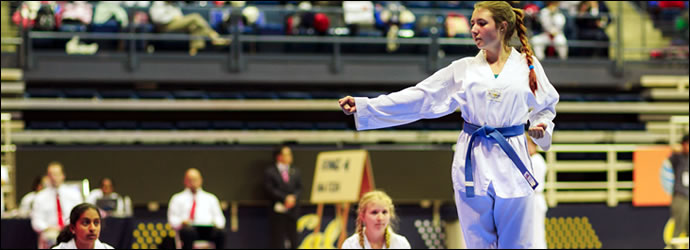
SPARRING. This is most the familiar type of competition and is found in the Olympics: two people, wearing protective gear, use a variety of skills to strike their opponent. Training for sparring is an excellent way to become more comfortable with applying techniques against a real person in addition to improving mobility, timing, and adaptability.
FORMS. Forms competition is fun for all ages as it does not require combat; it requires grace, power, and flexibility of movement in addition to the unified purpose of mind and body. Forms competition can be done individually or as a team and is gaining popularity around the world.
BREAKING. Requirements for breaking competition include degree of difficulty, precision, power, speed, and creativity. Board breaking is a visually exciting, rewarding, and satisfying challenge to apply skills.
SELF-DEFENSE. This can also be called “arranged sparring” and is a more recent type of competition. Two or more people demonstrate pre-arranged techniques against ‘attackers’ and demonstrate various ways to defend themselves. This is a very exciting type of competition that can be very creative.
Go to: Taekwondo Competition
Learn more about the fun and excitement of taekwondo competition.
NOTE: Safety is always a priority. Members participate according to their experience and can decline participating in any drill and watch and learn should they feel like doing so.
Rank Advancement / Promotion Exams (Return to Top)
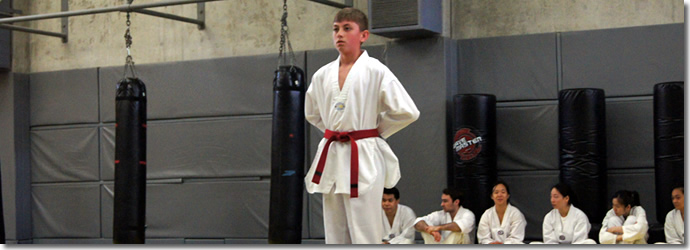
Approximately twice per year (generally summer and winter), we hold a rank promotion examination. These exams allow members who have trained and prepared during the previous months to be tested for their next rank. The rank system starts at white belt (10th geup) and moves up through yellow belt, green belt, blue belt, red belt (1st geup), and black belt (1st dan and up).
Eligible candidates for the promotion exam are expected to fulfill all rank requirements.
Go to: Taekwondo Exam Information
Learn more about MSMAP Taekwondo Exam requirements and purpose.
On The Way To Black Belt (Return to Top)
Our curriculum is based upon the international standards set by the Kukkiwon, the world taekwondo authority. Promotion Exam requirements follow those of the University of California-Berkeley Martial Arts Program (UCMAP) thereby assuring that participants who successfully pass each promotional examination have their rank recognized around the world.
The Kukkiwon serves as the issuing body for taekwondo dan rank (black belt degree) promotion and certification. In addition, the Kukkiwon conducts research and instructional seminars and is home to the World Taekwondo Academy, which trains and certifies Taekwondo instructors through its leadership course.
Safety (Return to Top)
A safe training environment is the most important goal of the Mount Shasta Martial Arts Program. We want people to walk out the door at the end of training in relatively the same condition that they walked in. In addition to respecting the safety of themselves, all members are required to respect the safety of others.
All Are Welcome (Return to Top)
People of all ages are welcome to participate in taekwondo. Children under 8 years of age must be accompanied by a parent. Even better, the parent is encouraged to participate, free of charge with their child(ren) or in any other MSMAP activity.
More Information (Return to Top)
Go to: Ready to Join
Go to: Children and Taekwondo
Go to: Children and Martial Arts
|
|
|
|
|
|
|
Axe Kick (Summer Exam, 2008)
|
|
|
|
|
|